What adenosine is (a nucleoside, on the label as Adenosine)
Adenosine is a nucleoside: the base adenine joined to a ribose sugar. It is one of the building blocks of DNA and the core of ATP, the molecule every cell uses to carry energy.
Because the body makes it, adenosine is not exotic. It is a signalling molecule that cells release and recognise through four receptor types (A1, A2A, A2B, A3). On a cosmetic ingredient list it appears simply as Adenosine; the EU cosmetic ingredient database gives it one function, skin conditioning, and lists it as synthetic in origin (COSMILE / CosIng).
In Korea, adenosine has a second life. It is one of the ingredients the Ministry of Food and Drug Safety (MFDS) recognises for wrinkle-care functional cosmetics, and 0.04% is the strength used in that category (Kim et al., Biomedical Dermatology, 2018; adenosine creams appear by name in the MFDS standards for functional cosmetics — ChemLinked, 2015). That is why so many Korean face serums carry it.
A short history of adenosine on the scalp
- 2000s · Japan
Shiseido's hair laboratory studies adenosine in cultured dermal papilla cells — the small cluster of cells at the base of each hair follicle — and reports that it switches on growth-factor genes (Iino et al., J Invest Dermatol, 2007).
- 2005 · Japan
Shiseido releases Medicated Adenogen, a scalp lotion with adenosine as its active ingredient (Shiseido, 2014 release). In Japan it is sold in the "quasi-drug" class, the regulated category between cosmetics and medicines (product listing, Sundrug).
- 2008 · Japan
The first published randomised, placebo-controlled trial of 0.75% adenosine lotion, in women (Oura et al., J Dermatol, 2008).
- 2015–16 · Japan and Europe
Two more randomised trials, in Japanese men and in Caucasian men (Watanabe et al., 2015; Iwabuchi et al., 2016).
- 2020 · Philippines
The first systematic review of topical adenosine pulls the trials together (Ke et al., Acta Medica Philippina, 2020).
- 2024 · Korea
A Korean laboratory group studies adenosine's effect on the androgen-receptor pathway in dermal papilla cells and runs a four-month trial of a 0.75% adenosine complex (Kim et al., Int J Mol Sci, 2024).
What the adenosine scalp research shows
Four randomised, double-blind trials have tested 0.75% adenosine lotion on the scalp. All four used the same strength, applied twice a day, and all four measured the same kind of thing: the proportion of hairs that are thick (60 micrometres or more) versus vellus-like (under 40 micrometres), counted on photographs of a fixed patch of scalp.
| Trial | Who | Design | What was measured |
|---|---|---|---|
| Oura 2008 | 30 Japanese women with female pattern hair loss | 0.75% adenosine vs placebo lotion, twice daily, 12 months, double-blind | Dermatologist and investigator ratings, phototrichograms (anagen rate, thick-hair rate) |
| Watanabe 2015 | 102 Japanese men with androgenetic alopecia | 0.75% adenosine vs niacinamide lotion, twice daily, 6 months, double-blind | Dermatologist global rating, % thick and vellus-like hairs, hair density, self-assessment |
| Iwabuchi 2016 | 38 Caucasian men with androgenetic alopecia | 0.75% adenosine vs placebo, 6 months | Change in % thick hair, % vellus hair, hair density |
| Kim 2024 | Korean adults with pattern hair thinning | 0.75% adenosine with panthenol and niacinamide, 4 months | Hair density and thickness by image analysis |
In plain words: in each of these trials, the adenosine group ended with a higher share of thick hairs than the comparison group, and the authors reported no adverse events attributable to the lotion. The 2020 systematic review, covering 260 participants, concluded that topical adenosine "may be effective in increasing thick hair ratio" and called for more studies (Ke et al., 2020).
Three things are worth holding onto. The trials are small — 30 to 102 people each. They were run or supported by the company that sells the lotion, which is normal for cosmetic research and still worth knowing. And they ran for six to twelve months, because hair works on long cycles; nothing in this literature reports a change in weeks.
These trials studied medical conditions — female pattern hair loss and androgenetic alopecia — and are described here as history. Skandoir serums are cosmetics. They are not intended to treat hair loss or any other condition, and we do not quote the trials' percentages as a promise about our products.
How adenosine is thought to work — studied in the lab
The proposed mechanism comes from cell and tissue work, not from people. In cultured dermal papilla cells, adenosine raised the expression of fibroblast growth factor-7 (FGF-7), and the effect was blocked by an antagonist of the A2B adenosine receptor — pointing to that receptor as the switch. Adding FGF-7 to human hair follicles in organ culture lengthened the hair fibre (Iino et al., 2007). Earlier work from the same group reported that adenosine also raised vascular endothelial growth factor (VEGF) in these cells (summarised in Oura et al., 2008).
A 2024 Korean study added a second idea: in dermal papilla cells, adenosine appeared to dampen androgen-receptor signalling, and in human follicle organ culture it extended the growth (anagen) phase (Kim et al., 2024).
All of this is laboratory biology. It explains why researchers chose adenosine; it does not, on its own, tell you what a bottle will do on a head.
The vehicle question: why 0.75%, and why a leave-on lotion
Strength is only half the specification
Every published scalp trial used 0.75%. Not 0.5%, not 1%: 0.75%, in a leave-on lotion applied twice a day. If a serum is going to borrow the trials' credibility, it has to borrow the trials' strength and format.
That is harder than it sounds. In plain water at 25 °C, adenosine dissolves to only about 5 grams per litre — 0.5% — and it is listed as insoluble in ethanol (PubChem, citing the CRC Handbook). Warming and a lower pH increase its water solubility. So 0.75% sits above the plain-water limit, and the vehicle — the glycols, the pH, and how the adenosine is dissolved during manufacture — decides whether that strength stays in solution or quietly drops out of it in the bottle.
The second half of the specification is leave-on. Adenosine has to stay on the scalp to reach the follicle. A rinse-off shampoo or masque washes it away in minutes, which is why the Blac Forest Protein Hair Masque deliberately contains none.
How Skandoir uses adenosine
Skandoir uses adenosine at the strength and in the format the trials used, and tells you so on the front of the bottle.
| Skandoir serum | Adenosine | With | Format |
|---|---|---|---|
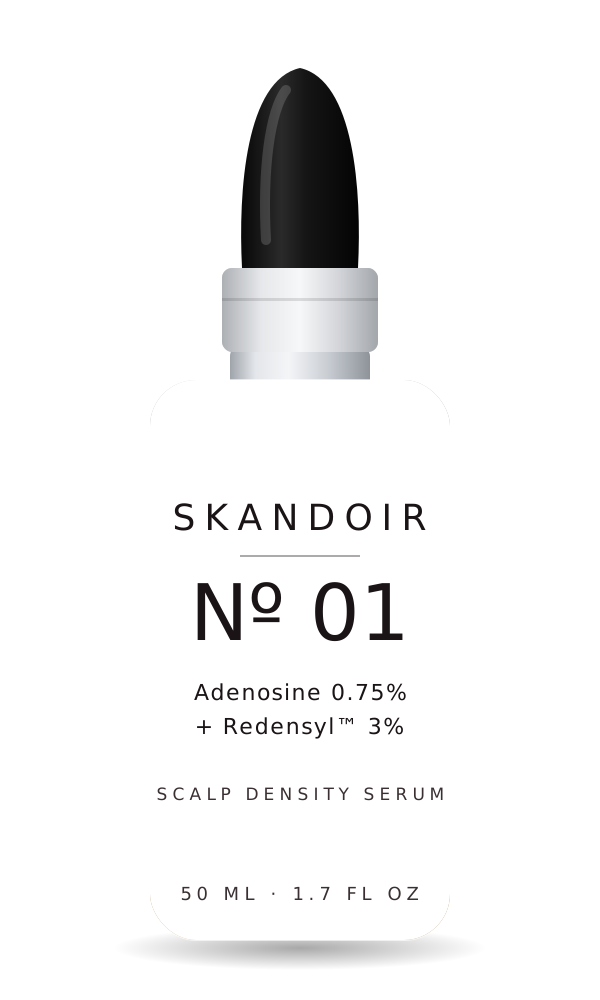
| Nº 01 · Adenosine 0.75% + Redensyl™ 3% | 0.75% | Redensyl™ 3%, caffeine, two hair peptides, creatine, PDRN 0.1%, ectoin | Night, leave-on lotion, one pipette across the partings |
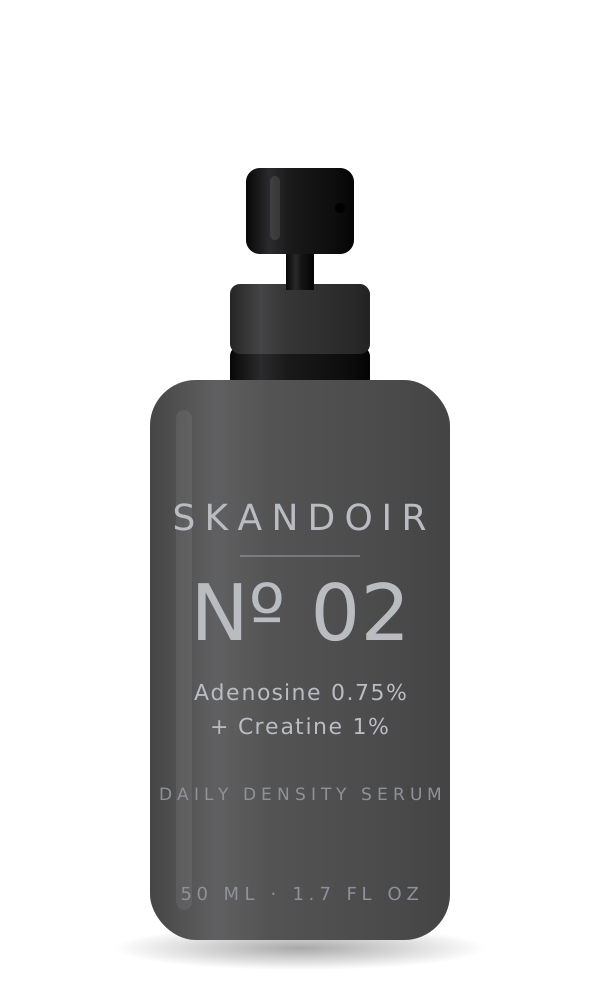
| Nº 02 · Adenosine 0.75% + Creatine 1% | 0.75% | Creatine 1%, caffeine, PDRN 0.1%, rice protein, ectoin | Morning, leave-on fine mist at the roots |
| Nº 03 · Copper Peptide 0.1% + PDRN 0.1% | 0.04% | Copper peptide, PDRN, Tripeptide-32, ectoin 2% | Night face serum |
| Nº 04 · Niacinamide 4% + Ceramide | 0.04% | Niacinamide 4%, ceramide trio, lipid vitamin C, ectoin 2% | Day face serum |
The two face serums carry adenosine at 0.04%, the strength Korea's functional-cosmetic standard uses for wrinkle care. The two scalp serums carry 0.75%, the trial strength. All four are side by side on Skandoir serums compared.
How Skandoir handles it
- An alcohol-glycol leave-on base for both scalp serums, matched to the trial format, so 0.75% stays in solution and the serum dries in minutes without oil or residue.
- Twice a day across the two products: Nº 02 in the morning, Nº 01 at night — the trials' dosing rhythm, split into a mist and a lotion so neither feels like a chore.
- Frosted matte-silver glass for Nº 01, so you see the lotion's natural pale-amber tint, and a full-black bottle for Nº 02. Adenosine is light-sensitive, so each bottle lives in a rigid box — keep it closed and out of the sun.
- A 24-week scalp study on Indian volunteers is planned before we publish any result. Until it reports, we tell you the molecule, the strength and the vehicle — and nothing more.
How to judge an adenosine scalp serum
Whichever brand you buy, four questions separate a serum that follows the research from one that borrows its name.
- Is the strength on the label? The trials used 0.75%. "With adenosine" could mean 0.04% — fine for a face cream, a different proposition for the scalp.
- Is it leave-on? Adenosine in a shampoo or a rinse-off mask is washed away before it can do anything.
- What is the vehicle? A water-and-glycol or alcohol-glycol lotion that dries fast and can hold 0.75% in solution. A thick oil cannot carry it to the scalp.
- Can you keep it up for 24 weeks? No trial reported a result before six months. If the texture, the smell or the grease will stop you by week three, the strength does not matter.
Adenosine for the scalp: questions and answers
Is adenosine the same as caffeine?
No. Both are small molecules that act on adenosine receptors, but caffeine blocks them while adenosine activates them. Skandoir Nº 01 and Nº 02 carry both: adenosine 0.75% as the hero molecule, with caffeine as a supporting active.
Can I use adenosine on the scalp every day?
Yes. Every published scalp trial applied 0.75% adenosine lotion twice daily for six to twelve months and reported no adverse events attributable to it. Skandoir's rhythm is Nº 02 in the morning and Nº 01 at night.
Does adenosine work on the face too?
Adenosine is a recognised wrinkle-care ingredient in Korea's functional-cosmetic system, used at 0.04%. Skandoir Nº 03 and Nº 04 carry it at that strength. The scalp and face uses are different strengths for different purposes.
Why 0.75% adenosine and not more or less?
Because 0.75% is the strength every published scalp trial used. It also sits above adenosine's plain-water solubility, so the vehicle has to be built around it — which is why we specify the format as well as the number.
Is 0.04% adenosine in a face serum worth anything?
It is the strength Korea's regulator recognises for wrinkle-care functional cosmetics, and the strength most Korean face serums use. In Skandoir Nº 03 and Nº 04 it is a supporting active, not the hero; the heroes are copper peptide and niacinamide.
How long before I should judge an adenosine scalp serum?
Give it 24 weeks. Hair works on long cycles, and no trial reported a change before six months. Skandoir will report its own 24-week scalp study on Indian volunteers when it completes.
Sources for this Adenosine for the scalp article
- Oura H, Iino M, Nakazawa Y, et al. Twelve-month double-blind, placebo-controlled trial of 0.75% adenosine lotion in 30 Japanese women with female pattern hair loss. Journal of Dermatology, 2008; 35(12):763–767.
- Watanabe Y, Nagashima T, Hanzawa N, et al. Topical adenosine increases thick hair ratio in Japanese men with androgenetic alopecia. International Journal of Cosmetic Science, 2015; 37:579–587.
- Iwabuchi T, Ideta R, Ehama R, et al. Topical adenosine increases the proportion of thick hair in Caucasian men with androgenetic alopecia. Journal of Dermatology, 2016; 43:567–570.
- Iino M, Ehama R, Nakazawa Y, et al. Adenosine stimulates fibroblast growth factor-7 gene expression via adenosine A2b receptor signaling in dermal papilla cells. Journal of Investigative Dermatology, 2007; 127:1318–1325.
- Kim J, Shin JY, Choi YH, et al. Hair Thickness Growth Effect of Adenosine Complex in Male-/Female-Patterned Hair Loss via Inhibition of Androgen Receptor Signaling. International Journal of Molecular Sciences, 2024; 25:6534.
- Ke BN, Villena JPDS, Frez MLF. Efficacy and Safety of Topical Adenosine for Androgenetic Alopecia in Adults: A Systematic Review. Acta Medica Philippina, 2020; 54(3).
- Kim HJ, Jung MS, Shin JM, et al. Verification of air brush effectiveness using cosmeceutical ingredients. Biomedical Dermatology, 2018; 2:24 (MFDS recognises adenosine as an anti-wrinkle ingredient; 0.04%).
- ChemLinked. Korea amends functional cosmetics testing regulation (Standards and Testing Methods of Functional Cosmetics), January 2015.
- Shiseido. Press release on the Shiseido Cell-Processing and Expansion Center, April 2014 (Medicated Adenogen released 2005; Adenovital Scalp Essence 2011).
- Sundrug Online. Shiseido Medicated Adenogen EX — product listing (quasi-drug classification; adenosine listed as active ingredient).
- COSMILE Europe. Adenosine — INCI detail (CosIng function: skin conditioning).
- PubChem. Adenosine (CID 60961) — solubility: 5.1 g/L in water at 25 °C; insoluble in ethanol (CRC Handbook of Chemistry and Physics, 88th ed.).
This page is educational and is not medical advice. Skandoir serums are cosmetics; they are not intended to treat any condition. For skin or hair disease, see a doctor.
Last reviewed: 13 October 2026